
By BOWE UK & Ireland · Updated 6 November 2026
There are seven main types of warehouse robots: autonomous mobile robots (AMRs), automated guided vehicles (AGVs), robotic arms, goods-to-person systems, sorting robots, inventory drones and pallet-handling robots.
Each one automates a different job, from moving totes between pick faces to sorting parcels for despatch. Most warehouses start with one type and add others as volumes grow.
This guide to the types of warehouse robotics explains how each type works, where it fits, how they compare and how to choose. It also shows where BOWE UK & Ireland’s robots and software fit in.
Why warehouses are adopting robots
Robots take on the repetitive moves that tie up people and forklifts: carrying goods between areas, feeding stations and sorting outbound orders. Robot adoption in logistics is growing quickly. The International Federation of Robotics reports that 102,900 professional service robots for transportation and logistics were sold worldwide in 2024, up 14%, more than for any other application (IFR, October 2025).
Safety is the other driver. In Great Britain, around 2.4% of transportation and storage workers sustained a non-fatal workplace injury each year between 2022/23 and 2024/25, against 1.8% across all industries (HSE, November 2025). Automating repetitive handling and vehicle movements can reduce people’s exposure to those risks. It doesn’t remove the need for a site risk assessment.
Robots help warehouses:
- Reduce manual handling and walking time
- Make throughput more predictable, especially at peak
- Improve picking and sorting accuracy
- Add capacity in stages rather than through a full site redesign
The 7 main types of warehouse robots
Each type of warehouse robot suits a different job. Here’s how each one works, what it’s best for, its limits, and where BOWE can help.
1. Autonomous mobile robots (AMRs)
AMRs carry totes, carts and shelves around the warehouse without fixed tracks, tape or magnets. They map the site with sensors and SLAM (simultaneous localisation and mapping), plan their own routes and steer around people, pallets and forklifts.
Read more
Best for: moving goods from pick faces to packing, replenishment, kitting and feeding conveyors or sorters. They suit sites where layouts and volumes change.
Limits: payloads are lower than pallet robots, and performance depends on clear aisles and good Wi-Fi.
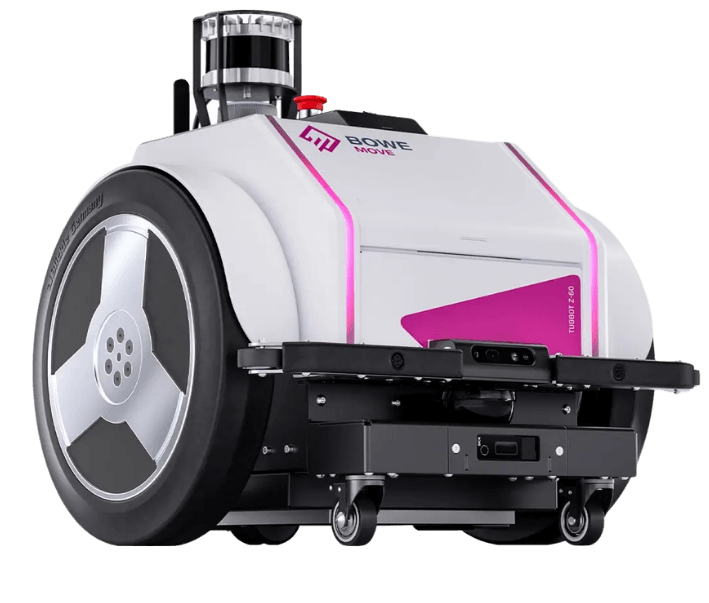
At BOWE: TugBot pulls carts with a pull force of up to 600 kg and runs for up to 8 hours on a 25-minute charge. The Bear Robotics Carti 100 carries up to 100 kg across three shelves for 9–11 hours per charge. Find out more in our guide to how autonomous mobile robots support intralogistics.
2. Automated guided vehicles (AGVs)
AGVs follow fixed routes marked by wires, magnetic tape or reflectors. They repeat the same journey reliably but stop when something blocks the path, rather than going around it.
Read more
Best for: high-volume, stable routes that rarely change, such as production lines feeding a warehouse.
Limits: changing a route means changing the infrastructure, so they’re less flexible than AMRs.
At BOWE: BOWE Intralogistics supplies AGVs and AMRs as part of conveyor and material flow projects.
3. Robotic arms and robotic pickers
Robotic arms use multi-axis joints, grippers and vision cameras to pick and place items. They handle repetitive picking, packing, kitting and palletising at a fixed station.
Read more
Best for: high volumes of predictable items at one workstation.
Limits: mixed, fragile or irregular items still need careful gripper selection and testing. Arms don’t move goods around the site.
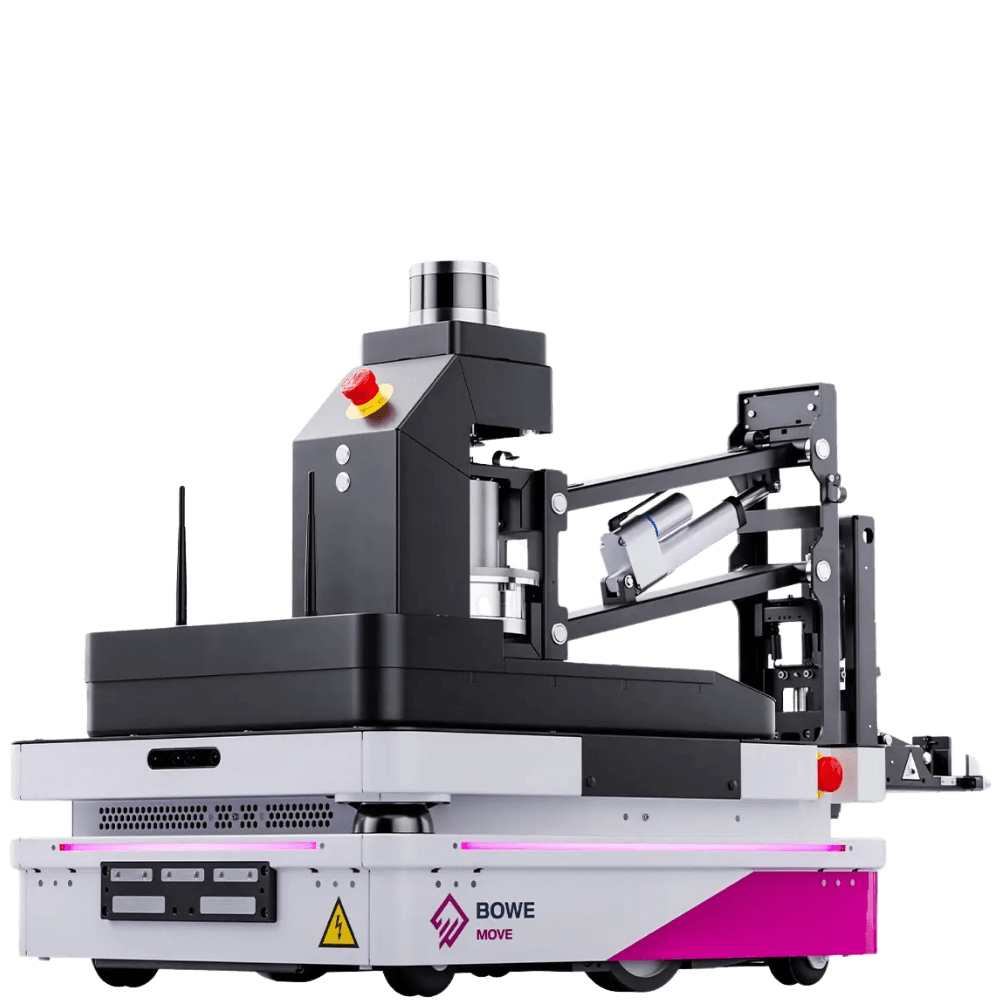
At BOWE: FlexxBot is a mobile robot with a gripper arm for material supply. It tows up to 1,000 kg and carries up to 250 kg.
4. Goods-to-person (G2P) systems
G2P systems bring stock to the picker instead of sending the picker to the stock. Robots or shuttles retrieve totes or shelving units and deliver them to an ergonomic picking station.
Read more
Best for: order fulfilment with many SKUs and small order lines, such as e-commerce and retail.
Limits: usually a bigger upfront investment and design project than AMRs. Automated warehouse solutions like G2P work best when planned alongside storage and software.
At BOWE: BOWE Intralogistics designs goods-to-person systems as part of wider conveyor and picking projects. We also provide field service for A Perry’s fleet of 17 HIK Q7 goods-to-person robots, which bring racking to pickers who follow instructions from the WMS we built for A Perry.
5. Sorting robots
Sorting robots divert parcels, packets and totes to the right destination after a barcode or vision scan. They range from fleets of small mobile robots that drop items into chutes, to robot arms at a sort station.
Read more
Best for: outbound and parcel sortation, multi-client third-party logistics (3PL) sites and operations where SKUs change often.
Limits: for high-volume, repeatable flows, mechanical sorters are usually faster. See the section on sorting robots below.
6. Inventory and inspection drones
Drones fly through high-bay aisles scanning barcodes or RFID tags and feed the data into the WMS. They speed up stock counts in tall racking that is slow to check from the ground.
Read more
Best for: cycle counts and stock audits in large high-bay sites.
Limits: still emerging, with battery life, flight rules and site safety to plan for. RFID scanners at fixed points are often a simpler way to improve stock visibility.
7. Forklift and pallet-handling robots
Pallet robots and automated forklifts move full pallets between goods-in, storage, production and despatch. They navigate autonomously and work alongside people and manned forklifts.
Read more
Best for: repetitive pallet moves over the same routes, shift after shift.
Limits: manned forklifts may still be needed for trailer loading and unusual loads.
At BOWE: PalletBot handles Euro, UK and CHEP pallets and lifts loads up to 1.3 m high. Read more in our guide to how forklift automation improves warehouse safety and efficiency.
Warehouse robot types compared
| Robot type | Main job | Navigation | Typical load | Flexibility to change | Best suited to | BOWE option |
|---|---|---|---|---|---|---|
| AMR | Moving totes, carts and shelves | Free navigation (SLAM), no tracks | Carts up to 600 kg (towed) | High | Changing layouts, picking and replenishment | TugBot, Carti 100 |
| AGV | Repeating fixed transport routes | Wires, tape or reflectors | Light to heavy | Low | Stable, high-volume routes | BOWE Intralogistics AGVs |
| Robotic arm | Picking, packing, palletising | Fixed station | Individual items or cases | Medium | High volumes of predictable items | FlexxBot (gripper arm on a mobile robot) |
| Goods-to-person | Bringing stock to the picker | Shuttles or robots in storage | Totes and shelving units | Medium | Many SKUs, small order lines | Automated warehouse solutions |
| Sorting robot | Diverting items to destinations | Mobile fleet or fixed station | Parcels, packets, totes | High | Changing SKUs, multi-client 3PL | Robotic sortation |
| Inventory drone | Stock counts and audits | Free flight in aisles | Scanners only | Medium | High-bay stock checks | RFID scanners (alternative) |
| Pallet robot | Moving full pallets | Free navigation, works alongside forklifts | Full pallets, up to 1.3 m lift | High | Repetitive pallet moves | PalletBot |
Most warehouses combine two or three types. For example, pallet robots move goods from goods-in to storage, AMRs feed the pick and pack area, and a sorter handles outbound. What connects them is the software layer: your warehouse management system and a warehouse control system (WCS) that tells each robot what to do next.
What are the best sorting robots for warehouses?
The best sorting robot depends on how predictable your flow is. Robotic sortation suits changing SKUs and sites with no room for building work. Mechanical sorters remain the fastest option for high-volume, repeatable flows.
- Mobile sorting robots: fleets of small robots carry single items to chutes or bags. They’re easy to scale by adding robots, and they suit multi-client 3PL and e-commerce sites where the product mix changes.
- Robot arms at a sort station: these pick items from a tote or conveyor and place them in destination bins. They suit mixed, irregular items at moderate volumes.
- Modular mechanical sorters: a modular sorter gives conveyor-level speed without a fixed, site-wide installation. The Modular Vertical Sorter (MVS) sorts up to 9,800 trays an hour across up to 97 destinations, installs in 1–2 days and takes an extra 10-chute module in about 45 minutes.
If you’re comparing options, start with throughput per hour, item size and weight range, number of destinations, floor space and how often your product mix changes. Our sortation systems page compares cross belt, shoe, push tray and robotic sorters in more detail.
How to choose the right type of warehouse robot
Start with the bottleneck, not the robot. Map where people spend the most time moving, walking or waiting, then match a robot type to that job.
- Map your flows: measure travel distances, pick rates and where queues form at peak.
- Match the job to the robot: pallet moves suit pallet robots, tote and cart moves suit AMRs, outbound volume suits sorters.
- Check your layout: aisle widths, floor quality, Wi-Fi coverage, doors and lifts all affect what will work.
- Plan the integration: robots need to connect to your WMS, WCS or enterprise resource planning (ERP) system. Our warehouse systems integration team connects new robots to the systems you already run. Smaller integrations may take weeks; larger multi-system deployments can take several months.
- Phase the roll-out: start with one route or area, measure the results, then add robots. Our guide on how growing operations can scale warehouse automation explains a phased approach.
Industries using warehouse robots
- E-commerce and retail: AMRs, goods-to-person and sorting robots for picking, packing and outbound sortation.
- Parcel and postal: sorting robots and mechanical sorters for parcel and letter sortation.
- 3PL: AMRs, sorting robots and pallet robots for multi-client picking and despatch.
- Manufacturing: AGVs, AMRs and pallet robots for line-side supply and moving finished goods to storage.
- Food and beverage: pallet robots and AGVs for pallet moves to and from cold storage.
- Healthcare: AMRs for moving supplies and lab specimens.
How BOWE helps
BOWE UK & Ireland supplies, integrates and services warehouse robots as part of a wider intralogistics system, not as standalone machines. Our UK engineering team is based in Derby.
- BOWE Move: TugBot, PalletBot and FlexxBot autonomous mobile robots
- BOWE IQ: WMS, WCS and integration software that connects robots to your systems, plus the Bear Robotics Carti 100
- BOWE Intralogistics: conveyors, sortation and the MVS
We also service robot fleets we didn’t supply. For example, we provide field service for A Perry’s 17 HIK goods-to-person robots, alongside the new WMS we built for them.
Future trends in warehouse robotics
- Mixed fleets: robots from different suppliers working together under one fleet manager.
- Robots as a service: paying monthly instead of buying outright. The IFR reports that robot-as-a-service (RaaS) grew by 42% in 2024.
- Better vision and AI: robots that handle more mixed and irregular items.
- Software-led optimisation: WMS and WCS data used to assign tasks and balance robot workloads in real time.
Next step: talk to an engineer about where robots would fit in your warehouse.
FAQs
The seven main types are autonomous mobile robots (AMRs), automated guided vehicles (AGVs), robotic arms, goods-to-person systems, sorting robots, inventory drones and pallet-handling robots.
AMRs navigate freely using sensors and maps and steer around obstacles. AGVs follow fixed routes marked by wires, tape or reflectors and stop when the path is blocked. AMRs are easier to redeploy when your layout changes.
Goods-to-person systems and robotic picking arms suit high-volume picking. AMRs that carry totes between pickers and packing suit sites that want to reduce walking time without changing their storage.
Mobile sorting robots and robot arms suit changing SKUs and multi-client sites. For high-volume, repeatable flows, a mechanical or modular sorter is usually faster.
Yes. AMRs and modular sorters can start with a single route or a few robots and grow as volumes increase, without a full site redesign.
Robots need fleet management software, plus a connection to your WMS or WCS so they know which tasks to do. A systems integrator connects the robots to the systems you already run.
Yes. AMRs and pallet robots are designed to operate safely alongside people and manned forklifts. You still need a site risk assessment before go-live.

